


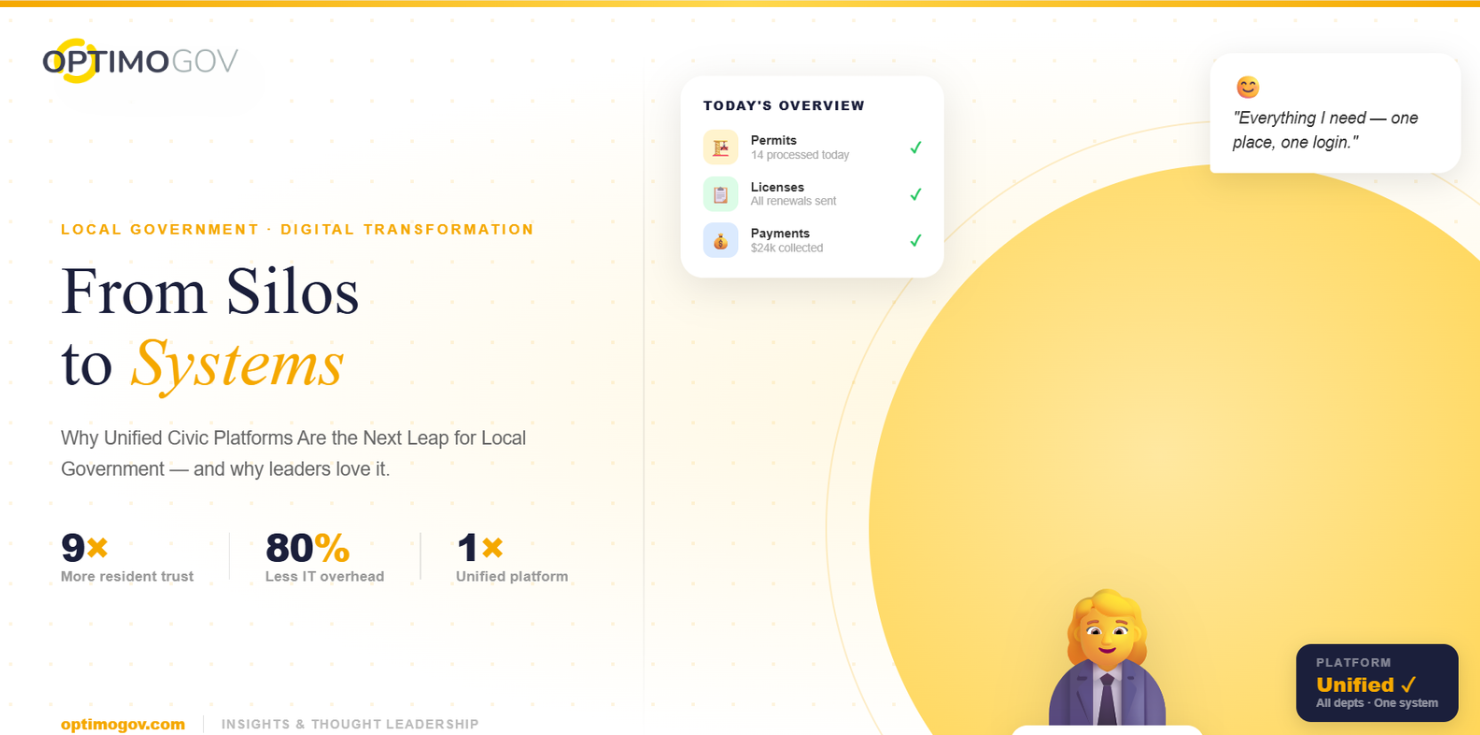
The Legacy Trap: A Foundation Built on Fragments
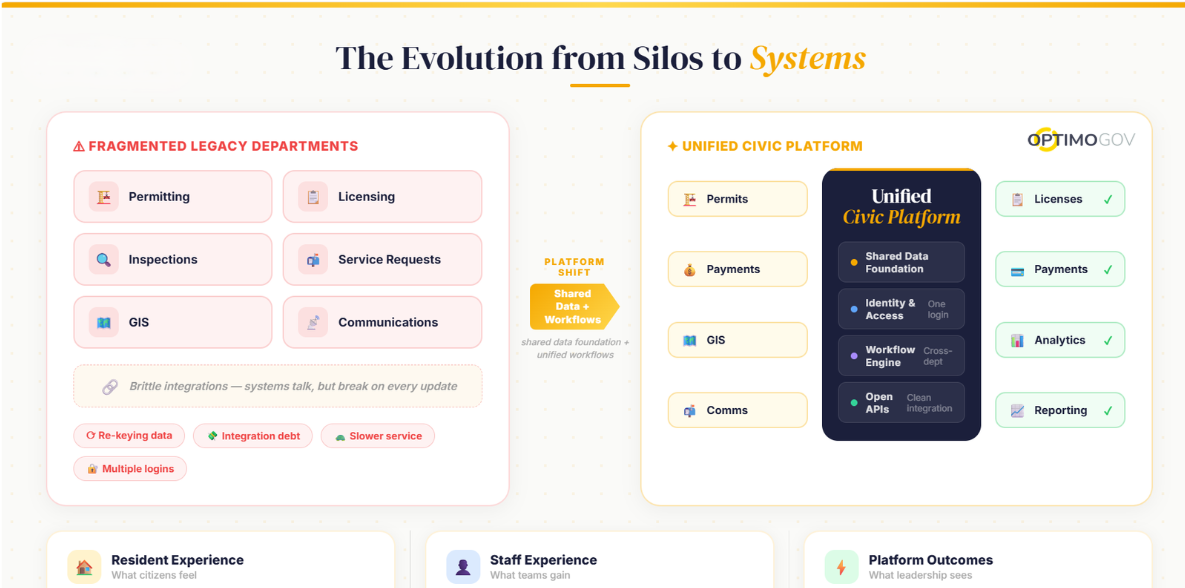
For years, local governments have bought different software for every department. The fire department has one system, the building permit office has another, and the parks department has a third.
We call this Legacy Trap. It’s similar to wearing a medical cast: it feels “safe,” but it stops you from moving. This creates two big problems:
- For Residents: A “tax” on their time. Entering the same address five times to book a park or pay a fine is a friction point that erodes trust.
- For Staff: The “Swivel-Chair” burden. Employees spend their days toggling between five different screens just to process a single permit. This doesn’t just waste time; it kills morale and slows public service to a crawl.
The High Cost of “Swivel-Chair” Government
The “swivel-chair” effect is more than a nuisance; it’s a hidden tax on the taxpayer. Research from NASCIO suggests that “integration debt”, the cost of maintaining connections between old systems, can consume up to 80% of an IT budget.
When a government operates through silos, it suffers from three primary drains:
- Data Integrity Erosion: If a contractor’s license information lives in three different systems, an update in one risk of inconsistency in the others. Inconsistency triggers rework and, occasionally, legal liability.
- The Switchboard Syndrome: Residents call three numbers because no single system is the “system of record.” Staff become switchboard operators rather than problem solvers.
- The Procurement Carousel: Every time a siloed “point solution” needs an upgrade; it triggers a ripple effect of broken integrations, sucking hundreds of vendor hours.
Unified platforms transform operational drag into measurable throughput. The ‘single pane of glass’ isn’t just an aesthetic choice; it is an efficiency engine that returns thousands of hours to public service.
What Residents Expect (and Governments Know They Owe)
Residents no longer compare their city’s digital services to the neighboring town; they compare them to Amazon, Uber, and DoorDash. This shift has created a new standard for civic engagement.
1. The Amazon Effect
Citizens expect to track progress in real-time, check balances instantly, and get digital answers. They expect to:
- Track Progress: Just like a pizza or a package.
- Check a Balance: Just like their banking app.
- Get an Answer: Instant, accurate, and digital.
When a grocery app offers more transparency than a building permit process, resident frustration is a rational response to poor service.
2. The Trust Factor
Efficiency isn’t just about saving time; it’s about building a relationship with the community.
- The Data: A McKinsey & Company study found that citizens are nine times more likely to trust a government agency when they are satisfied with its digital services.
- The Struggle: Most municipal leaders are stuck playing catch-up, watching delays pile up in “hotspots” like permits, inspections, and service requests.
3. The Failure of “Band-Aid” Fixes
Many cities try to fix problems one department at a time, but this often backfires:
- The Trap: Adding a specialized tool to make life easier for one department usually makes life harder for three others.
- The Shift: This is why experts are calling for Platform Thinking.
4. Moving Toward “Platform Thinking”
Instead of buying more individual tools, cities need a new architecture that:
- Reduces Duplication: Stop asking for the same data in different forms.
- Standardizes Data: Ensures every department is looking at the same “truth.”
- Focuses on Journeys: Designs systems around what the resident is trying to achieve (e.g., “Starting a Business”) rather than how the city is organized.
Why Now? The AI and Compliance Imperative
We are at a technological tipping point where the “status quo” has become a risk factor.
- AI Readiness: Generative AI is only as smart as the data it can access. If records are siloed or poorly labeled, AI will “hallucinate” or provide incomplete advice. A unified platform creates the essential training ground: clean, contextual, and consented data. Without this foundation, a city’s AI strategy is just a collection of expensive toys.
- The Privacy and Audit Burden: Data privacy laws and accessibility standards are becoming stricter. Managing compliance across twenty different apps is a losing battle. Centralizing into one system allows you to set security rules once and apply them globally.
Defining a Unified Civic Platform
Let’s strip away the buzzwords. A Unified Civic Platform is a modular system that behaves coherently. It integrates case management, permitting, licensing, inspections, and payments onto a shared data foundation.
Five traits define a true platform:
- One Data Model: A single, governed source of truth for people, places, and transactions.
- Cross-Department Workflows: Approvals and handoffs move smoothly without manual re-entry.
- Policy Configuration: Rules, fees, and forms managed through settings, not custom code.
- Open Integration: Standards-based APIs so specialized systems like GIS or Finance plug in clean.
- Embedded Intelligence: Automation that learns from your city’s specific historical data.
When these traits show up together, cities stop buying “solutions” and start building.
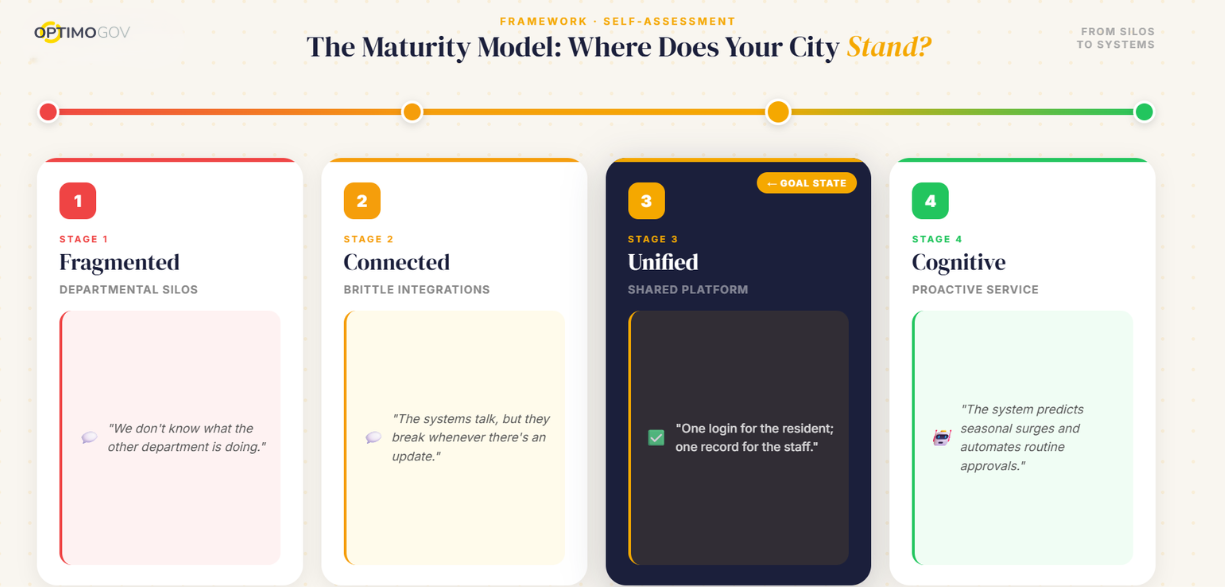
The Maturity Model: Where Does Your City Stand?
To move forward, leaders must assess their current state. Most municipalities fall into one of four stages:
What Good Looks Like: The “No-Wrong-Door” Experience
Picture a resident applying for a block party permit. In a unified world:
- They log in at once. The system recognizes they have an outstanding utility balance and prompts a payment before proceeding, protecting revenue.
- The system pre-fills their address from the GIS record.
- The workflow automatically triggers notifications to Police (traffic), Sanitation (bins), and Fire (access).
- If a conflict exists, say, a water main repair scheduled for that day, the system flags it before the application is submitted.
Ready to modernize your infrastructure? North America | OptimoGov

Shantha Ruban is the founder of OptimoGov and the Group CEO of Programus Ltd, the software group behind OptimoGov’s council booking and venue/event management platform. With 30+ years in software R&D, he has led the development of technology solutions for large venues and events.